FLOTTANT: optimised energy chains for hybrid marine energy harvesting
CEMLab takes part in FLOTTANT, a project funded by the EU's Interreg NEXT Italy–Tunisia programme and coordinated at the laboratory by Prof. Nabil Derbel. The project develops a hybrid system that harvests energy from several marine sources.
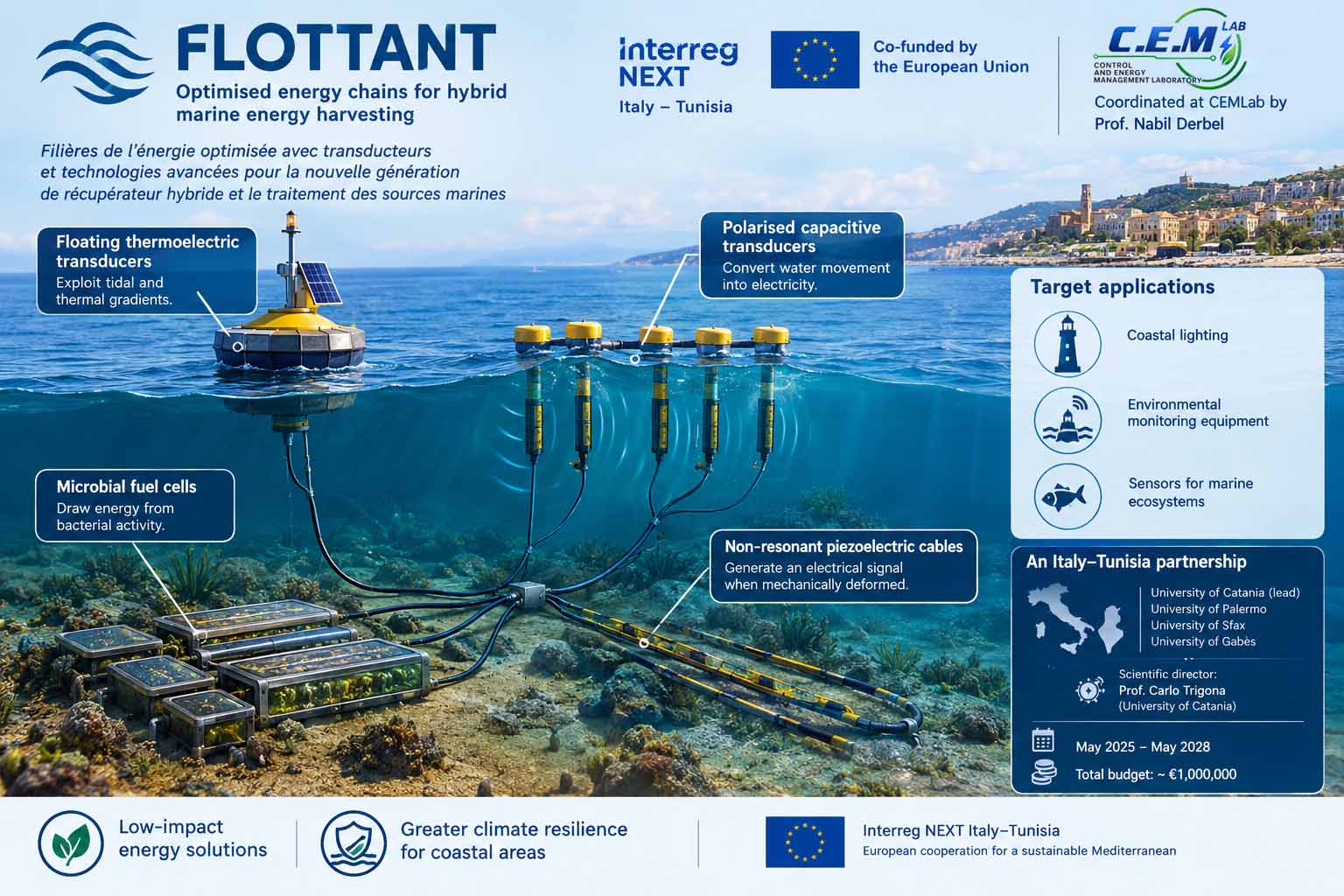
FLOTTANT — Filières de l'énergie optimisée avec transducteurs et technologies avancées pour la nouvelle génération de récupérateur hybride et le traitement des sources marines — is a Mediterranean research project on renewable marine energy. It is coordinated at CEMLab by Prof. Nabil Derbel.
An Italy–Tunisia partnership
The project is co-funded by the European Union through the Interreg NEXT Italy–Tunisia programme, with a total budget of about €1 million. It started in May 2025 and runs until May 2028. The University of Catania leads the consortium, with the University of Palermo and the Tunisian universities of Sfax and Gabès. Prof. Carlo Trigona (University of Catania) is the scientific director.
The kick-off meeting took place at the University of Sfax, with officials from the partner universities and representatives of the Interreg programme. Prof. Nabil Derbel presented work on the modelling and dynamic study of the transducers.
Harvesting energy from the sea
FLOTTANT aims to build an innovative system that can recover, combine and optimise energy from several marine sources. It combines complementary technologies:
- microbial fuel cells installed on the seabed, which draw energy from bacterial activity;
- polarised capacitive transducers that convert water movement into electricity;
- non-resonant piezoelectric cables that generate an electrical signal when mechanically deformed;
- floating thermoelectric transducers that exploit tidal and thermal gradients.
Target applications include coastal lighting, environmental monitoring equipment and sensors for marine ecosystems. The wider goals are low-impact energy solutions and greater climate resilience for coastal areas.
Sources: CEMLab activity report 2025 (LR11ES47), section III-3; UnictMagazine; AGI.
Recent Posts